


In this article, we use so-called affiliate links. With every purchase through these links, we receive a commission from the merchant. All relevant referral links are marked with . Learn more.

The seven test participants
The full comparison, including assessments of the light profile, operation, build quality and mounting, can be found in the Parent article on battery-powered spotlights for Aero cockpits.
- Amazon LF 36 Bicycle Light Set >> available here
- Busch & Müller Ixon Rock >> available here
- Cateye GVolt 80.1 >> available here
- Lezyne Macro 500+ Reverse Mount >> available here
- Lupine SL Grano F Silver Edition >> available here
- Sigma Aura 100 with Out Mount Front mount >> available here
- Trelock Lighthammer 100
The quotient shows the time balance
For the purposes of the analysis, the lighting duration is divided by the charging duration. A value of 1.0 means that the headlamp shines for exactly as long as it takes to fully charge. If the ratio is higher than this, the lamp provides more lighting time than charging time. The higher the value, the more favourable the outcome for riders who have little time to recharge between two rides.
The Busch & Müller Ixon Rock achieves the best result. After a charging time of 2 hours 50 minutes, it provided 3 hours 10 minutes of light in the test. This gives a ratio of 1.12. Mathematically, this means that for every hour spent plugged in, around 67 minutes of light are available. The Ixon Rock is the only model whose runtime exceeds its charging time.
Amazon is the fastest to load
The Amazon LF 36 bike light set achieved the shortest charging time in the test at 2 hours 20 minutes. Its burn time of 2 hours 24 minutes is only slightly longer than this, giving a ratio of 1.03. This ratio is favourable for short, regular rides. However, the absolute runtime remains limited at less than two and a half hours.
Compared with the Amazon light, the Ixon Rock offers significantly longer battery life and, at the same time, better overall performance. For longer training rides in the dark, this is more important than the 30-minute shorter charging time of the cheaper Amazon set.
Trelock lasts the longest
The Trelock Lighthammer 100 achieves the longest recorded runtime of 3 hours 35 minutes. This gives it the greatest reserve for long evening rides. However, it takes 4 hours and 40 minutes for the battery to fully recharge. This is the longest charging time among the models tested and brings the ratio down to 0.77.
Lezyne, Sigma, Cateye and Lupine also remain below 1.0 in terms of runtime. The Lezyne Macro 500+ Mount Reverse provides 3 hours 15 minutes of light, but takes four hours to charge. The Sigma Aura 100 offers 2 hours 40 minutes of run time, compared with 3 hours 20 minutes spent on the mains. Cateye and Lupine each achieve a ratio of 0.74.
The display and installation remain crucial
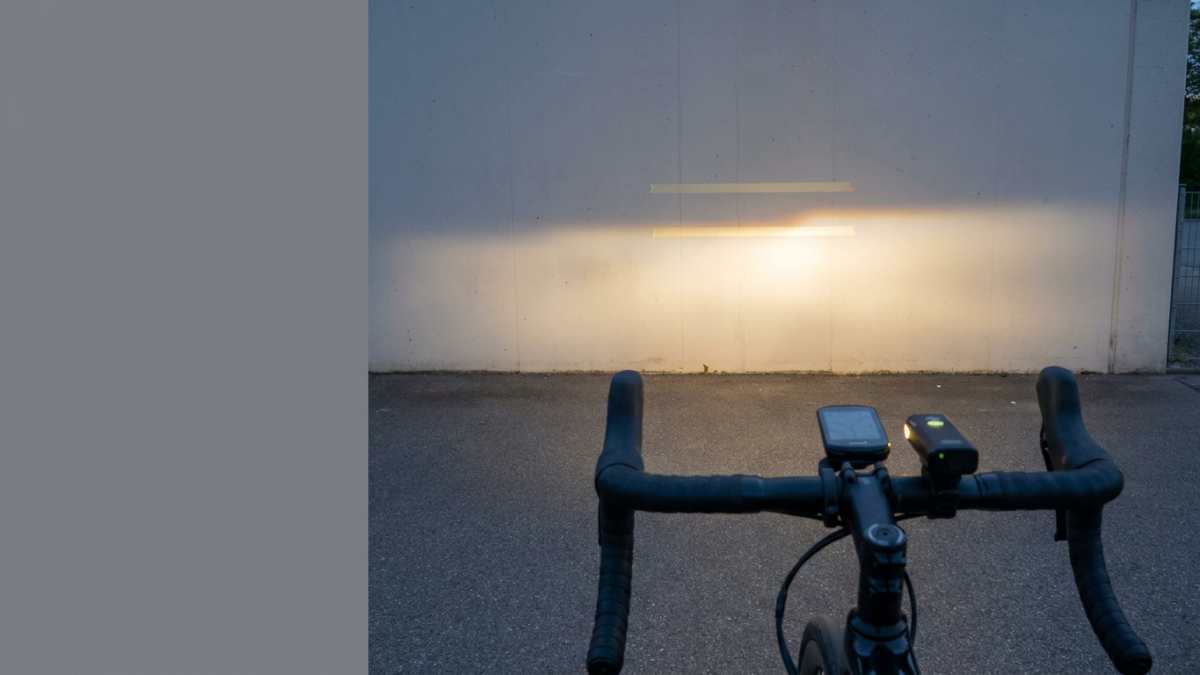
The beam-to-light ratio complements the test but does not replace an assessment of the light pattern. For fast driving on dark roads, what matters is how evenly a headlamp illuminates the near field, the edge of the carriageway and the far field. Equally important are a clear battery level indicator and a mount that does not slip on the front mount.
When it comes to battery life, the Busch & Müller Ixon Rock comes out on top. Amazon charges the quickest, whilst Trelock offers the longest burn time. Ultimately, however, the choice of which light is best suited to a road bike depends on how it will be used: a short commute, a regular after-work ride, or a long training ride in the dark.

Matthias Borchers
Editor
