


Our conclusion on this topic
Carbon is not an automatic guarantee of quality, but rather a tool for targeted design. The material usually offers the greatest value for money in wheelsets, as this is where reduced mass and improved aerodynamics come together. In seatposts, carbon can improve comfort through targeted compliance, though the effect depends heavily on the specific design. With frames, weight, stiffness and design flexibility are genuine advantages, but these aren’t always clearly noticeable in everyday use. TOUR measurements show that tyres, wheels, forks, frames and seatposts must be considered as an integrated system. Those who invest wisely therefore do not necessarily ride the most expensive carbon bike, but rather the most well-balanced one.
Carbon is regarded as a premium material for road and gravel bikes. The material is lightweight, can be moulded into almost any desired shape and, depending on the fibre orientation, can be designed to be very stiff or specifically flexible. However, carbon is not automatically the better choice. The key factor is which component the material is used in and which riding characteristics actually benefit from it.
A carbon frame can save several hundred grams compared to a similar aluminium frame. In everyday use, however, this difference is often less noticeable than the effect of a lightweight wheelset or a comfortable seatpost. With wheels, aerodynamic benefits are also a factor alongside weight. When it comes to the cockpit, ergonomics and aerodynamics are more important than weight. With carbon-fibre cockpits, however, there is greater freedom in terms of design. Aerodynamically designed handlebars are therefore usually made of carbon.

It’s also worth taking a closer look at comfort. Carbon itself does not automatically offer better shock absorption than aluminium. The decisive factors are the design, tube shapes, wall thicknesses, fibre lay-ups – and the overall set-up with the frame, tyres and seatpost. Bulky tyres provide a large part of the damping or suspension. On race bikes optimised for propulsion and rolling resistance, however, a comfortable carbon seatpost can take on this role. Measurements from the TOUR laboratory therefore paint a nuanced picture: high stiffness around the bottom bracket can be beneficial, whilst too much stiffness elsewhere compromises comfort.
The key takeaway is therefore that carbon fibre is particularly worthwhile where several advantages come together. For other components, aluminium is often the more economical solution and is hardly any worse in everyday use.
Carbon wheels: the best value for money?
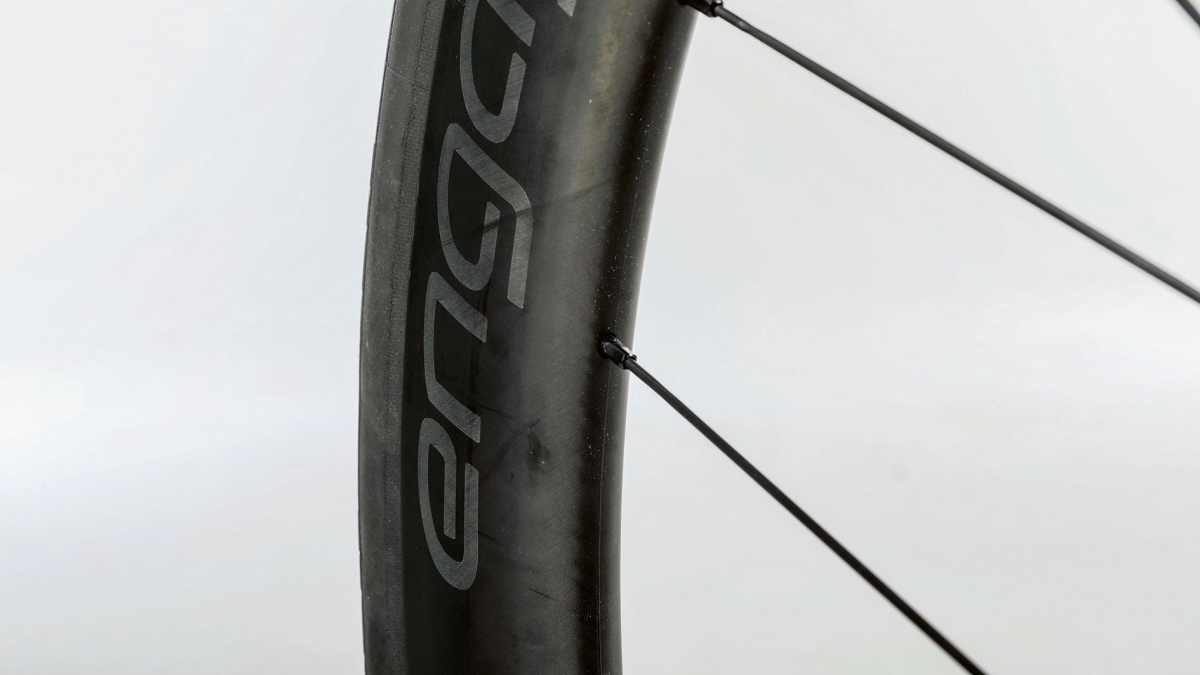
If you want to make your aluminium or carbon bike noticeably faster, upgrading your wheels is usually the most effective way to do so. A modern carbon wheelset can be several hundred grams lighter than a standard aluminium wheelset. It’s not just the total weight that matters. With wheels, the mass is situated far out on the rim and tyre, and has to be set into rotation with greater force every time you accelerate.
This effect is particularly evident:
- on short climbs
- when there are frequent changes of pace
- when accelerating out of tight bends
- during fast road bike and gravel rides involving lots of changes of direction
In addition, higher rim profiles offer an aerodynamic advantage. TOUR tests wheelsets in a wind tunnel at angles of attack ranging from minus 20 to plus 20 degrees and consolidates the measurement results into a drag coefficient. This captures not only the theoretical advantage under perfectly straight airflow, but also the influence of oblique crosswinds.
A high-profile carbon wheel can therefore be both lighter and faster. This dual benefit is why carbon wheels are often the most sensible investment for road bikes. On gravel bikes, however, this applies only to a limited extent. On technical terrain, low to medium rim profiles are often more suitable. They are less susceptible to crosswinds and do not necessarily suffer when coming into hard contact with stones or roots.
Price examples for aluminium and carbon wheelsets
| Typical surcharge | Effect | Costs and benefits | |
| From a basic aluminium wheelset to a carbon road bike wheelset | around 600 to 1,500 euros | Less rotating mass, better aerodynamics | Excellent on a road bike |
| Aluminium gravel wheelset to carbon gravel wheelset | around 500 to 1,200 euros | Weight, and in some cases better acceleration | Good for gravel races, but has its limitations for bikepacking |
| High-profile carbon wheels | around 800 to 2,000 euros | Aerodynamics at higher speeds | Excellent for fast road races |
Carbon wheels are not without their drawbacks, however. With rim brakes, particular attention must be paid to heat and braking performance. With disc brakes, this problem is significantly less of an issue; nevertheless, repair costs and susceptibility to severe damage remain relevant concerns.
Conclusion: For a sporty road bike, carbon wheels are often the upgrade that makes the biggest difference. With a gravel bike, whether it’s worth it depends more on how you intend to use it.
Carbon frames: lighter weight, more possibilities
The carbon frame offers the greatest design flexibility. Whilst the shape and wall thickness of aluminium tubes are more restricted by the manufacturing process, carbon fibres can be laid in specific directions. This allows the head tube, bottom bracket area, chainstays and seatstays to be designed with different properties.
The most important advantage remains the weight. A good carbon frame can save a few hundred grams compared to a comparable aluminium frame. However, this advantage is often offset by the components fitted. A budget carbon bike is not automatically lighter than a high-quality aluminium bike. Heavier wheels, tyres, cranksets or a simpler groupset can completely negate the frame’s weight advantage.
How significant is the gain in stiffness?
Carbon offers high stiffness combined with low weight. However, this does not mean that every carbon frame is stiffer than every aluminium frame. It all comes down to the design. A carbon frame designed for comfort may be deliberately stiff around the bottom bracket, yet still offer excellent vertical damping properties.
TOUR measures bottom bracket stiffness using a test rig that simulates pedalling. The test measures the extent to which the bottom bracket deflects under a defined load. High values indicate minimal deformation and therefore direct power transfer. In recent TOUR measurements, very good road bike systems have achieved a combined stiffness of frame and fork of more than 9 newtons per millimetre. Weaker systems achieve 5 newtons per millimetre or less. However, these figures should not be interpreted directly as a comparison between ‘carbon and aluminium’, as frame size, construction and intended use have a significant influence.
Is a carbon frame more comfortable?
Carbon fibre can be more comfortable, but it doesn’t have to be. Comfort is primarily achieved through:
- Tyre width and tyre pressure
- Seat post and its extension length
- Seat stays and seat tube
- Fork design
- Handlebars and handlebar tape
- Frame size and riding position
In principle, a road bike is a chain of several spring and damping elements connected in series. The weakest – or most compliant – element has a particularly strong influence on the overall ride feel. The tyres achieve lateral stiffness values of around 40 to 50 N/mm, which is a range that is highly relevant to handling. Wheels typically have values of around 45 to 50 N/mm, with a wide variation depending on their design.
This explains why an aluminium frame with 32-millimetre tyres can offer a more comfortable ride than a stiffly tuned carbon bike with narrow tyres and high tyre pressure. The material alone is not the deciding factor.
Conclusion: A carbon frame is particularly worthwhile for riders who want to save weight, are looking for a high-quality all-round package, or want a very specific combination of stiffness and comfort. For many riders, however, a good aluminium frame with better wheels and tyres is the more economical solution.
Carbon seatpost: comfort rather than performance gains
When it comes to seatposts, carbon can be particularly useful if comfort is the main priority. A carbon seatpost can be specifically designed to deform in a controlled manner beneath the saddle. This reduces vibrations and harsh impacts on the rider.
The effect is more noticeable on long rides than the minimal weight saving. A carbon seatpost usually saves only a few dozen grams compared to a standard aluminium model. The improvement in comfort, on the other hand, can be particularly noticeable if the seatpost has a tube diameter of 27.2 mm and the seat tube tends to be short.
TOUR has already demonstrated just how significant this effect can be with the Ergon CF3. The special leaf spring design gave way by more than 14 millimetres under a test load of 100 kilograms. By comparison, a conventional carbon seatpost from Ritchey offered less than half that amount of travel. This shows that it is not the ‘carbon’ label that provides comfort, but the specific design.
With gravel bikes, the seatpost can be even more important than the frame. In the case of the Canyon Grizl CF8, TOUR found that the flex came mainly from the specially designed carbon seatpost, whilst the frame itself gave way only slightly. The stiff frame ensured a smooth ride and stability, whilst the seatpost took care of the comfort.
| Typical surcharge | Effect | Costs and benefits | |
| Aluminium, 27.2 millimetres | Basic | Sturdy, functional | Excellent value for money on a tight budget |
| Classic carbon seatpost | around 100 to 250 euros | Less weight, a little more cushioning | Fine, but it depends on the design |
| Carbon comfort or leaf spring support | around 200 to 400 euros | Significantly more vertical travel | Excellent over long distances |
| Aero or integrated carbon seatpost | often included in the package price | Aerodynamics, design, and to some extent comfort | Only useful if the frame construction is suitable |
Conclusion: For long road and gravel rides, a well-designed carbon seatpost is one of the most sensible carbon investments you can make. However, not every carbon seatpost automatically delivers significant benefits.
Carbon cockpit: light and comfortable, but not very flexible
The handlebars and stem affect handling, whilst the riding position influences aerodynamics and comfort in the hands and arms. Carbon can help reduce weight here and, thanks to the orientation of the fibres, can be specifically designed to offer a certain degree of flexibility. This can help reduce fatigue over long distances, particularly with drop handlebars featuring a flat top or specialised grip zones.
However, the gain in performance remains limited. A carbon handlebar does not automatically make a road bike faster. Aerodynamic advantages stem from the shape and position of the cockpit, not solely from the material.
A carbon cockpit is therefore particularly worthwhile in three situations:
- If the component is significantly lighter than the aluminium alternative
- If it is demonstrably more comfortably tuned
- If the shape allows for a more aerodynamic or ergonomically superior position
Integrated carbon handlebar-stem combinations have an additional practical drawback. The choice of widths and stem lengths is often limited. Changing them at a later date can prove expensive if the desired combination does not fit. Servicing work (replacing spacers, headset maintenance, etc.) also becomes technically more complicated. TOUR explicitly highlights the limited interchangeability and high replacement costs associated with such handlebar assemblies.
| Typical surcharge | Advantage | Disadvantage | |
| Aluminium handlebars and aluminium stem | Basic | Good value for money, flexibly adjustable | A bit heavier |
| Carbon handlebars with a separate stem | around 150 to 400 euros | Weight and comfort | Assembly requires care |
| Integrated carbon cockpit | around 400 to 1,000 euros | Weight, aerodynamics, appearance | Expensive and not very flexible |
Conclusion: A carbon handlebar can be worth it for the comfort it offers. An integrated carbon cockpit, on the other hand, is of particular interest to riders who know exactly what riding position suits them best and who value aerodynamics and aesthetics.
Carbon cranks: little comfort, limited weight saving
Carbon cranksets look technically sophisticated and are often fitted to very expensive road bikes. Their main advantage lies in their weight. Depending on the model, they can save anywhere from a few dozen to more than 100 grams compared to high-quality aluminium cranksets.
However, this has only a limited effect on handling. The cranks are positioned close to the axis of rotation, which is why the impact on acceleration is less than that of rims and tyres. There is virtually no improvement in comfort. High-quality aluminium cranks are also very stiff when it comes to power transmission.
For many cyclists, therefore, the money is better spent elsewhere. Anyone looking to save weight should start by checking their wheels, tyres and saddle. A carbon crankset is more of a component for a consistently lightweight build than an upgrade that makes a significant difference to the ride.
Conclusion: Technically interesting, but less cost-effective than carbon wheels or a comfortable seatpost.
Carbon fork: important, but often standard anyway
On modern road bikes and gravel bikes, the fork is almost always made of carbon. This also applies to many aluminium frames. The reason is not just the weight. Carbon allows for a precise balance between lateral stiffness, steering precision and vertical compliance.
However, the fork is not an isolated component. Its performance depends on the tyres, wheels, handlebars and head tube/frame design. A very stiff carbon handlebar can partially negate the comfort gains offered by a supple fork.
Carbon on gravel bikes: it all depends on how you use it
With gravel bikes, the choice of materials depends more on the intended use than with road racing bikes. A race gravel bike benefits from low weight, high bottom bracket stiffness and aerodynamically shaped tube cross-sections. This is where carbon can really show its strengths.
A bikepacking gravel bike, on the other hand, has to meet different requirements:
- high payload
- plenty of fixing points
- Contact with luggage and means of transport
- robust components
- simple repair options
- reliable performance on poor road surfaces
A good aluminium frame may be the better choice for this use. The weight disadvantage is less of an issue when carrying luggage, whilst the robustness and lower purchase price offer advantages. When it comes to wheels, aluminium rims are often sufficient for touring and everyday use. The advantage of carbon frames on gravel bikes is the design flexibility they offer. A frame storage compartment, for example, is often only found on carbon gravel bikes.
The best order for your upgrades
If you’re on a tight budget, you should choose carbon not for prestige, but for performance. For a road bike, the following order is often a good guide:
- Optimising tyres and tyre pressure: The impact on comfort, grip and rolling resistance is significant!
- Upgrading wheels: This combines weight savings with aerodynamics
- Check the seat post: A comfortable carbon seatpost can make long rides much more enjoyable
- Select handlebars: Ergonomics and comfort are more important than a slight weight advantage
- Deciding which carbon frame to buy: It only makes sense if the weight, geometry, handling stability or frame specifications offer clear advantages
- Replacing the cranks: Usually only relevant in the context of consistent lightweight construction or for aesthetic or image-related reasons

Josh Welz
Editor-in-Chief