


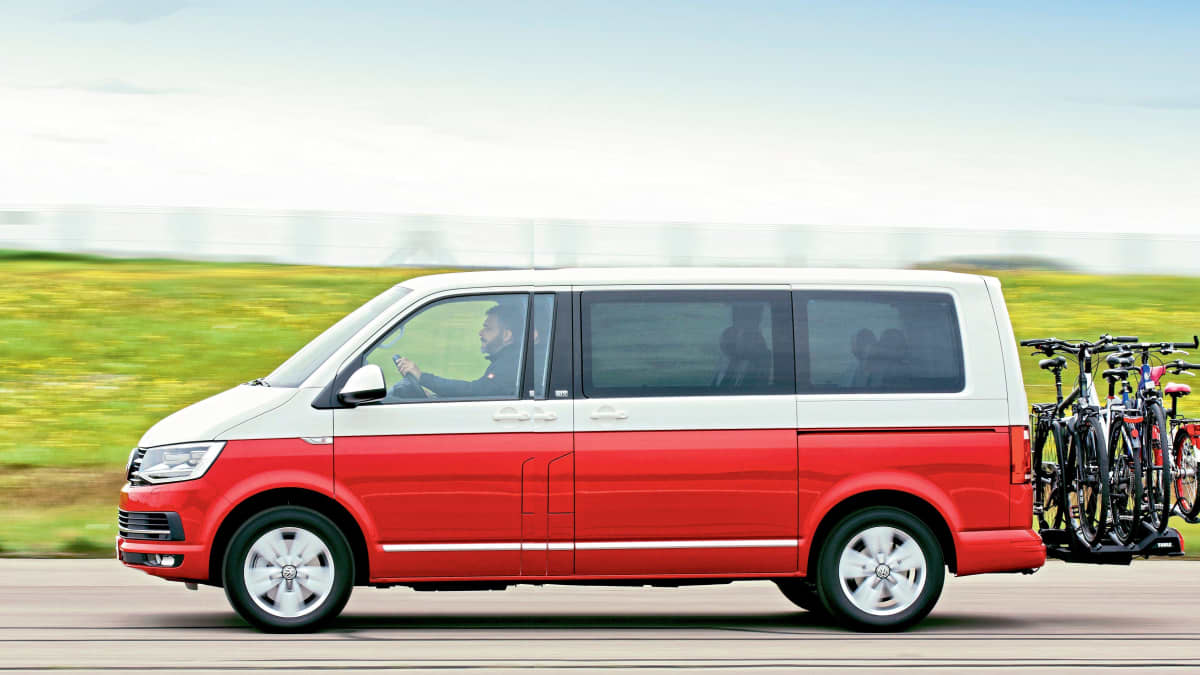
Although bike racks have a significantly smaller impact on driving dynamics than roof-mounted carriers, the additional load at the rear is not without effect. The vehicle’s centre of gravity shifts rearwards, placing greater stress on the rear axle whilst tending to relieve the front axle.
Changes in handling: noticeable, but manageable
In practice, this manifests itself in a longer braking distance and a slight change in steering response, particularly at higher speeds or during rapid load changes. On winding roads and in strong crosswinds, the vehicle reacts more sluggishly, but remains predictable provided you drive defensively. Anticipatory braking and gentle steering movements are the most important adjustments to make.
Speed: less is more
In Germany, there is no explicit speed limit for bike racks mounted on a tow bar. Nevertheless, many manufacturers specify a recommended maximum speed of 120 to 130 km/h . This recommendation should be taken seriously, as air turbulence, material stress and chassis forces increase significantly as speed rises.
In other European countries, different rules may apply. In some countries, reduced speed limits are either mandatory or implied. If you want to be on the safe side, it’s best to drive at a moderate speed even on the motorway – this is easier on the car, your nerves and your fuel consumption.

The maximum speed
- No explicit speed limit in Germany
- Manufacturers’ recommended maximum speed: 120–130 km/h
- Please note that regulations may differ in some other European countries
After setting off: check your bike rack rather than just trusting it
One aspect that is often underestimated is checking the bike after the first few kilometres. Straps can slip, the mounting arms on the bike rack can shift slightly, and tensioning mechanisms can give way. A quick stop after about ten to twenty kilometres is one of those simple routines that significantly improve safety.
All it takes is a quick check: Are all the fastenings secure? Is the bike wobbly? Is the bike rack still mounted on the tow bar without any play? These few minutes are particularly worthwhile on longer motorway journeys.
Driver assistance systems, sensors and a reversing camera
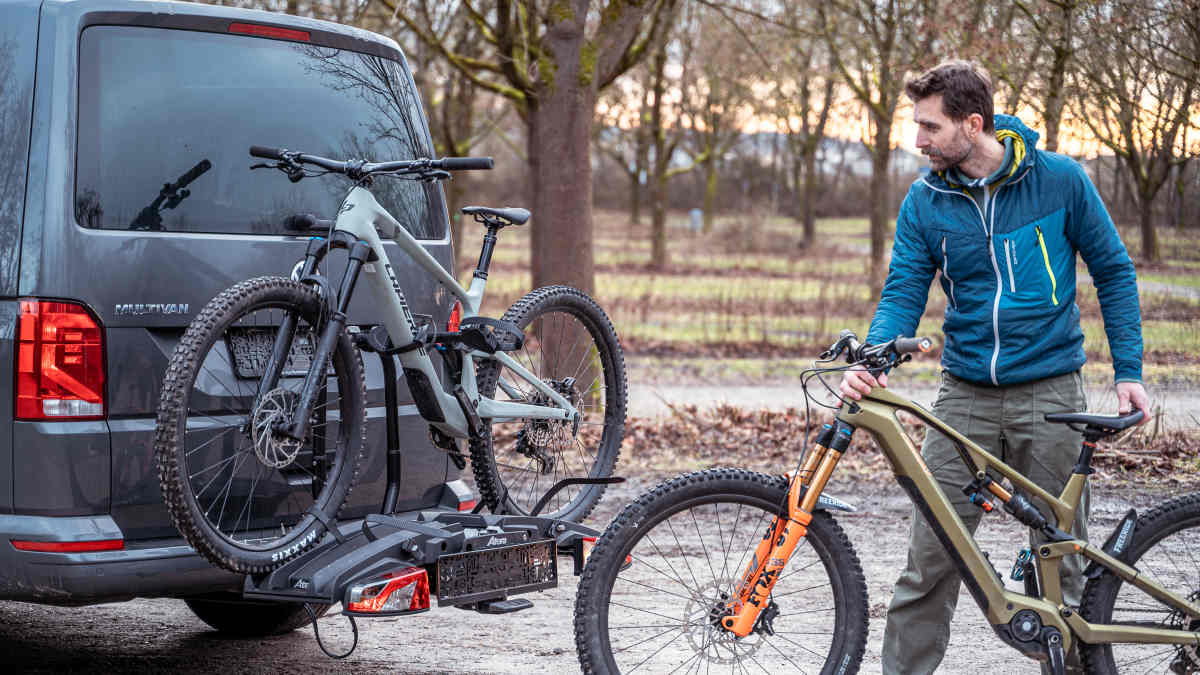
Modern vehicles are highly sensitive to rear-mounted accessories. Parking sensors trigger a continuous alarm, emergency braking systems interpret the bike rack as an obstacle, and reversing cameras become useless. Depending on the vehicle, these systems can be deactivated manually or automatically; in some cases, this only happens once the connector has been properly plugged in.
It is important to familiarise yourself with these functions before setting off. Blind reliance on driver assistance systems is no substitute for staying alert, particularly when manoeuvring in car parks or at campsites.
Reversing with a bike rack requires particular care. The extended overhang of the vehicle significantly alters distances and steering angles. Kerbs, bollards or steep ramps can quickly become a hazard for bicycles and racks.
Particularly on steep driveways or ferry ramps, it is advisable, if in doubt, to get out of the vehicle and assess the situation from the outside. Damage rarely occurs at higher speeds – but almost always whilst manoeuvring.
Driver assistance systems and manoeuvring – that’s what matters
- Check the driver assistance system and deactivate it manually if necessary
- Be extra careful when manoeuvring
- Changes to distances: Watch out for bollards, ramps and the like.
- Take care when leaving the ferry: risk of grounding
Legal matters when travelling: lights, number plates, abroad
A bicycle carrier fitted to the tow bar must be correctly lit at all times. Brake lights, indicators and tail lights must be in full working order, and the registration plate must be clearly legible. If any of the lights fail, the journey must not be continued.
Abroad, there are additional regulations to bear in mind. In Italy and Spain, for example, special warning signs are required, which must be attached to the outermost point of the trailer. Anyone travelling across borders should find out the requirements in advance – fines are a common consequence of ignorance.
Italy as a special case – the following applies:
- Mandatory labelling: Warning signs for loads protruding to the rear
- Number of warning signs: Two, one on each side of the vehicle’s full width (left and right)
- Minimum size: 50 x 50 centimetres
- Material: sheet metal
- Markings: Five red and white stripes
- Fine: at least 87 euros
- Penalty: Possible prohibition on continuing the journey
Breaks, parking and overnight stays with a bike rack
On longer journeys, it is advisable to keep a regular eye on the trailer even during breaks. Heat, rain or strong winds can have a lasting effect on the materials and the way the trailer is secured. Furthermore, the risk of theft increases when spending the night at service areas or campsites.
Integrated locks provide basic security, but are no substitute for the cyclist’s own vigilance. If you are stopping for a longer period, park in a busy, clearly visible spot where possible, and avoid leaving your bike overnight in a secluded area. Using a high-quality bike lock as an additional security measure is also recommended if you are leaving your bike for a longer period. However, you should remove the lock before setting off again to prevent damage to the paintwork or frame.

Stefan Frey
Editor