


Atera Strada Sport bike rack: A lightweight classic for road and gravel bikes
Stefan Frey
· 08.07.2026


In this article, we use so-called affiliate links. With every purchase through these links, we receive a commission from the merchant. All relevant referral links are marked with . Learn more.
Bike racks designed to fit onto a tow bar rarely stand out for their light weight and compact dimensions. We set out to find lightweight alternatives for transporting bikes and came across Atera, amongst others. With the Strada Sport 2 The German manufacturer offers a classic bike rack in its range, which aims to stand out primarily through its clear focus on low weight and ease of use. The rack is designed to carry two bikes, but can be upgraded to carry three bikes using an extension kit if required.
When compared with more modern models, it’s clear that the Atera Strada Sport 2 has been around for a few years. It doesn’t fold away as compactly as the other models in the test, but at 14.9 kilos it’s still pleasantly light. Nevertheless, it lacks, for example, a handle that would allow you to carry it comfortably to the tow bar.
The Atera is solidly built. All plastic and metal parts are deburred and pose virtually no risk of injury. The 13-pin plug sits in a handy holder. The folding mechanism can be easily activated using a foot pedal, and the rear lights can be moved further outwards using an Allen key if required.

A handy clamping lever, but difficult to fit
It is fitted to the towbar using an easy-to-operate clamping lever. A nice touch: a green indicator shows whether the rack is securely and correctly positioned on the towbar. However, fitting it onto the tow bar is a little more strenuous and fiddly than with the racks from Übler or Yakima, which have a handy handle and are fitted vertically rather than horizontally onto the tow bar.
The mounting bracket can be easily locked into place using two folding handles and is relatively wide. This provides a sufficient number of mounting positions for the clamping arms. Mounting the bikes themselves requires a little patience. Even when placing the first bike on the rack, the clamping arm for the second bike must be threaded through the frame. Although the clamps can be moved, they cannot be removed and repositioned – a feature that is actually quite common these days. On the plus side: the clamps are extensively rubber-coated and feature a locking mechanism that protects delicate carbon frames.
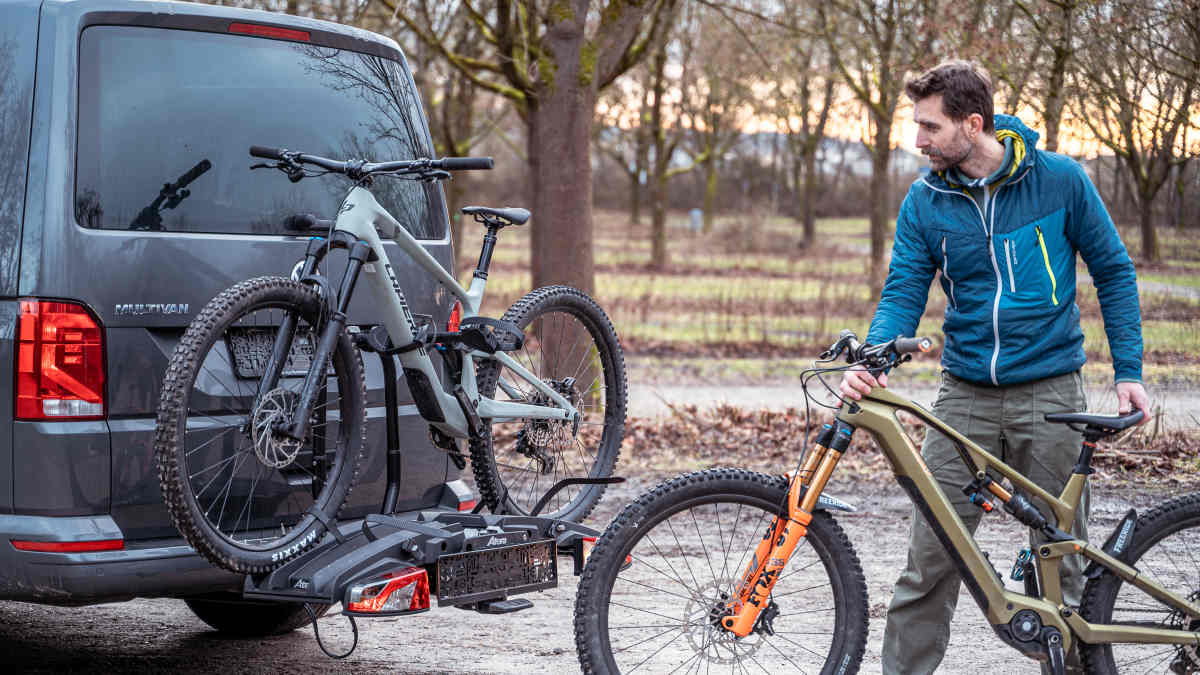
Too narrow for wide e-MTBs
Although the straps are sturdy, they are rather stiff. Securing them is rather fiddly overall, as all the ratchets on the wheel clamps face inwards. If operated incorrectly, the straps can also come loose quite easily. The adjustable wheel clamps are practical, at least for road bikes and gravel bikes, as the wheels and tyres sit very securely; however, they are less suitable for wide mountain bike tyres.
The Strada Sport 2’s biggest drawback is its extremely narrow rail spacing of just 18 centimetres. As a result, this bike rack is really only recommended for road bikes and gravel bikes. Anyone wishing to transport mountain bikes or e-bikes should opt for the e-bike version of the Atera Strada, which offers a significantly wider rail spacing and more space for wide rear triangles or fat suspension forks.
Atera Strada Sport 2 at a glance
- Price: 589 euros >> available here
- Variants: Available for 2 or 3 bikes; can be extended by one rail
- Assembly: Traditional clamping mechanism using a wide lever
- Folding function: Convenient activation of the tilt function via a foot pedal, double locking mechanism
- Weight: 14.9 kg
- Payload: max. 60 g / 30 kg per rail
- Dimensional tolerance: 100 x 20 x 59 cm
- Rail length / width / spacing: 99 / 7 / 18 cm
- Max. wheelbase / tyre width: 134 cm / 2.4 inches
- Max. pipe diameter: 25–80 mm
- Rack / Bikes can be locked: yes / yes
- Accessories: Extension to accommodate a third bike; ramp; wheel holders for tyres up to 4 inches
Conclusion & Review: Atera Strada Sport 2
| Grade | |
| Assembly (30%) | 2.3 |
| Handling (40%) | 3.3 |
| Features / Workmanship (10%) | 1.9 |
| Weight / Transport (20%) | 2.7 |
| BIKE-NOTE | 2.7 |
The Strada Sport 2 is a solid classic that appeals particularly to beginners and road cyclists. The build quality, stability and simple basic design are impressive, and the expandability is also a plus. In detail, however, the design feels a bit dated: fiddly loading, awkward straps and, above all, the narrow rail spacing set clear limits. The Strada Sport 2 is only of limited suitability for modern mountain bikes or e-bikes – in these cases, it’s better to opt for more up-to-date or specifically designed models such as the Atera Strada e-bike.
Advantages and disadvantages of the Atera Strada Sport 2
Advantages
- lightweight
- Secure, gentle tyre levers and wheel covers for gravel and road bikes
- good value for money
Disadvantages
- less compact when folded
- narrow track width makes it unsuitable for e-MTBs
- Cumbersome handling of gripper arms and clamping straps

Stefan Frey
Editor